My career plan- who do I want to be when I graduate (Section 3)

I. New skills to learn:

In order to achieve what I have as a goal in my mind, I need to develop research skills, the ability to understand things exactly how they are and not to distort the information given to me. What is more, I would need to enhance my creativity thinking, so I can bear with the time pressure. I may often have to come up with ideas fast to keep my business active. And I have to learn to adapt to different circumstances quickly and get used to both approval and harsh criticism, both success and failure.

II. My media diet:

I have to examine carefully how topics like fashion, arts, astrology are covered in other media outlets, because I want to become an expert in these categories. Of course I will not stop looking at recent news and exploring issues that concern contemporary society, but I will focus my attention on magazines like Cosmopolitan, Vogue, Elle, Apollo, The Sunday Times, ES, Grazia, Aesthetica. I will also listen to the radio and a variety of podcasts, like GrownUpLand, These things shall pass: delusions and how to survive them , Friday Night Comedy from BBC Radio 4 , Fortunately… with Fi and Jane , The Chris Evans’ Breakfast Show , Drama of the Week , Evil Genius with Russell Kane , Time Travellers , Late Night Woman’s Hour.

TV programmes like BBC, SkyNews, ITV, would also be helpful with expanding my general knowledge.

Bloggers I should keep up with include Felix Salmon, Adam Tinworth, David Higgerson, Mary Hamilton and Many Jenkins.

Twitter accounts that are worth following are: Matt Thompson, Andrew Sullivan , Claire Lehmann , Jason Willick and Stoycho Kerev.
creativity_11788813-1-resize

III. What optional modules I chose/ am about to choose:

I picked up Polylang (Russian) as an optional module in Year 1, and I will definitely do it again in Year 2, because apart from journalism, I have another passion- astrology, and I am planning to enrol on an astrology course in Russia. I am planning to do Fashion Journalism as my second optional module in Year 2. I will select Dissertation and Performing Arts Journalism in Year 3. I love and I am used to writing a lot, so 8000 words would not be that big problem. And there is an unconditional love between me and the theatre ever since I was a child and I think I will have a lot of fun during last year of my BA degree. By doing all these modules, I will combine everything that I like in my monthly piece of paper, which does not have a name yet, but I will come up with it soon.

IV. Work placements that would be helpful:

Grazia Magazine Editorial – contact

Fashion Journalism Work Placement – intern@wonderlandmagazine.com

Fashion Editorial Work Experience –  Magazine: nowmagletters@timeinc.com
Web: nowonline@timeinc.com

My career plan- who do I want to be when I graduate (Section 2)

I. What kind of journalist do I want to be? 

I would prefer to be a freelance writer and write about the things I like rather than be under the control of a boss. What is more, I really cannot imagine myself like a reporter, who goes out and gets the stories. I would fit more as a magazine editor, because I am good at making stories shine in a new way. That does not mean that I will not meet people and create my own articles; I just want to have the option to choose who these people will be. I do not mind interacting with people from all walks of lives: from ordinary people to celebrities and experts, depending on the topic I am writing about. However, most of the time I would prefer to stay in my well-equipped chaotic office, filled with books, newspapers, magazines and expensive paintings on the wall. There I will be with my own thoughts, as working with other people at the same room could damage my concentration and inspiration.

krant-en-koffie-23977949  videoblocks-young-business-woman-in-modern-office-skyscraper-in-the-talks-on-the-phone-standing-at-the-window-steadicam-shot_sxbdwudq5l_thumbnail-full04

I want to work in the entertainment sphere, because there is too much seriousness in the world, which I cannot fix, but maybe make sure that people have fun despite this.  Meanwhile, I could have another profession, either being a tutor at university or a motivational speaker in Mindvalley or TED. I have the ability to motivate, explain things simply and clearly and it makes me feel happy when I help others find their own path to success.

II. In which type of journalist do I fit? Using Matt Thompson’s Four Types of Journalists, I would say that I belong to two categories: The Provocateur and The Storyteller. It usually happens to me to discover something new in what is already known, or to present it in an innovative way, to refresh what the public thinks of it. I do not aim at finding scoops, but looking at something through a different angle. I like to take my time and examine things carefully before publishing something. The same thing applies to when I tell others’ stories. I get really inspired when I have intellectual discussions with various individuals, but then I need to be on my own to produce a masterpiece. I believe that the more people you meet, the more chances you have to find an extraordinary talent in them and expose it to your audience, when given the consent to do so. Read more about as which types of journalists I define myself with and another journalist who inspires me- Karbovski, HERE.

The US sanctions on Iranian oil saga continues

The focus on Tuesday is separated between three categories:

  1. Oil prices and exemptions
  2. European’s “clearing house”
  3. The unwillingness of Erdogan to abide by the US sanctions

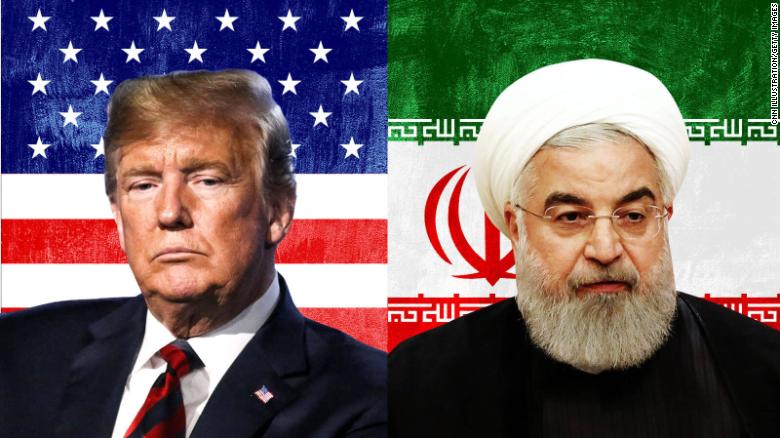
NDTV focuses on President Trump defending his decision to give temporary waivers to eight countries, saying it was done to keep oil global prices down, so that there is not a shock in the world market.

MarketWatch claims that oil declined Tuesday, sending U.S crude futures down for a seventh consecutive session-  the longest losing streak in nearly 20 months. It also talks about Trump and his will to “go a little bit slower” when it comes to sanctions on Iranian oil because he doesn’t walk to drive up oil prices. JMMC officials monitor implementation of crude output agreement that began on Jan. 1, 2017 between members and nonmembers. West Texas Intermediate Crude for December fell 1.4%, to settle at $62.21 a barrel on the New York Mercantile Exchange. January Brent crude fell 1.4%, to $72.13 a barrel on ICE Futures Europe.

chart (1)

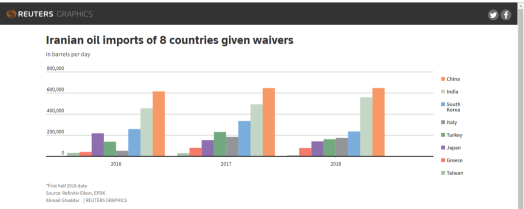
Link to Reuter’s Chart

CBC highlights the fact that although the fresh round of sanctions the U.S. imposed on Iran Monday threatens to close off all channels of international banking to the regime, it is unlikely to affect Canadian businesses.

Giving eight countries waivers to continue to buy oil from Iran may be a strategy to give those partners time to develop new sources of oil, or just not to upset the stability in the international oil markets, according to Ian Lee, an expert in international trade and associate professor at Carleton University’s Sprott School of Business in Ottawa.

The Guardian explains in detail about the European ‘clearing house’, which will allow European companies trading with Iran to bypass newly imposed US sanctions. It will possibly be set up in France or Germany.

Al Jazeera represents Turkey’s opinion expressed by President Recep Tayyip Erdogan and Foreign Minister Mevlut Cavusoglu. Erdogan states that US sanctions are wrong and are aimed at unbalancing the world, while Mevlut Cavusoglu thinks that it is dangerous to isolate Iran, pointing out that “instead of sanctions, meaningful dialogue and engagement is much more useful.”

NDTV

MarketWatch

CBC

The Guardian

Al Jazeera

Buzzfeed preview: pros and cons

In our Introduction to Journalism lecture I was assigned to take a look at a particular media website (mine was Buzzfeed) and share a preview of it on my personal blog.

The name of Buzzfeed means “getting feed instantly” . The site contains stories with long, catchy headlines that are likely to appear on top of search engines. What is more, these written pieces have “to sell and not to tell”.

Viewers are encouraged to share the stories on social platforms, such as Facebook, Twitter, LinkedIn, etc.

Buzzfeed is mostly for entertainment and celebrity gossip, but it has a piece of seriousness too (although you cannot notice that at first sight). Advertisements are placed on the sidebar and parallel with “news”.

Its style is plain, not eye-irritating with sparkling colours, popping ads and subscriptions.  The menu line is symmetrically divided – on the left we see the name of the site and five menus and on the right- the search engine alongside with five creative fast-click buttons that lead us to new content.

BuzzFeed

This site could appeal to the younger audience- from teenagers to young adults. It has sections with recipes, politics, parenting issues and even LGBT. To put it in a nutshell, it has a bite for everyone’s taste.

Where does the journalism hide in my weekly media consumption

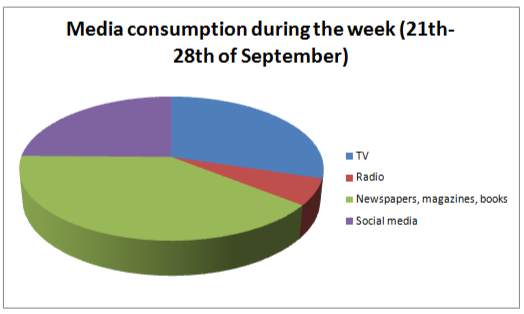
      I had been monitoring my media consumption for a week (21th- 28th of September) and I put the results in a chart below:

mediaconsumption (1)

      It turns out, as I expected, that I spent most of my time in reading newspapers- in print or online (Evening Standard, The Guardian), magazines (Cosmopolitan, Writing, ES Magazine), excerpts from books (Media, Culture and Society by Paul Hodkinson, Why study the media? by Roger Silverstone) during my everyday travel from home to university and vice versa – 36 hours.

      Some other 24 hours were spent by me watching TV at home after a hectic and yet exciting day in university (BBC, Sky News). In order for me to get a rest from the journalism world, I decided to post on social media and see how my friends’ day on Instagram was, and this took me 28 hours of my priceless time and a lot of my iPhone battery (after making this monitoring on consumption I am thinking of reducing the time spent on social media a bit) . Last, but not least, my radio consumption (BBC Radio 4) was 7 hours only.

     The conclusion to be drawn from the above, is the fact that I tried to balance my active hours between keeping up with the news and getting in touch with friends, colleagues and relatives. The one thing I would like to correct is the time I spend on social media, so that I could have free hours for some extracurricular activities.

‘We need much more critical reading’, says Felix Salmon in ‘Teaching journalists to read’

Felix Salmon’s piece of writing provides some good food for thought. My first reaction when reading the headline was, ‘Can’t journalists read properly, or is there something more than meets their eye?’ . It turns out, Felix has the ability to witness the biggest problems concerning journalism:

  1. He believes that what is missing in the journalistic establishment is people who are good at finding and curating great material.

The main focus on Salmon’s speech during The Audit’s breakfast, is that the journalistic entities- newspapers, magazines, websites, have to start putting much more emphasis on reading. The reason why he emphasizes on this was because journalism is becoming much more conversational.

Think about it this way: reading is to writing as listening is to talking — and someone who talks without listening is both a boor and a bore. If you can’t read, I don’t want you in my newsroom. Because you aren’t taking part in the conversation which is all around you.

2. According to Dean Starkman, journalists who no longer work for old-fashioned media cannot be called ‘journalists’ , while Salmon thinks quite the opposite, and here lies the second issue- between old-fashioned and contemporary media.

Both of them produce material worth reading. The difference between ‘now’ and ‘those halcyon days’ is that today we have got more high-grade journalism available to the public than ever before.

3. And last, but not least, it is not about the shortage of journalists, but that of critical readers, who absorb the information, without misinterpreting it.

What makes one person a good journalist is his ability to read between the lines, to engulf fully in a situation until all points of view are considered. Everyone can be a publisher on Twitter or Facebook, but not everyone can create a content worthy of notice.

Teaching Journalists to Read

Design a site like this with WordPress.com
Get started