The focus on Tuesday is separated between three categories:
Oil prices and exemptions
European’s “clearing house”
The unwillingness of Erdogan to abide by the US sanctions
NDTV focuses on President Trump defending his decision to give temporary waivers to eight countries, saying it was done to keep oil global prices down, so that there is not a shock in the world market.
MarketWatch claims that oil declined Tuesday, sending U.S crude futures down for a seventh consecutive session- the longest losing streak in nearly 20 months. It also talks about Trump and his will to “go a little bit slower” when it comes to sanctions on Iranian oil because he doesn’t walk to drive up oil prices. JMMC officials monitor implementation of crude output agreement that began on Jan. 1, 2017 between members and nonmembers. West Texas Intermediate Crude for December fell 1.4%, to settle at $62.21 a barrel on the New York Mercantile Exchange. January Brent crude fell 1.4%, to $72.13 a barrel on ICE Futures Europe.
CBC highlights the fact that although the fresh round of sanctions the U.S. imposed on Iran Monday threatens to close off all channels of international banking to the regime, it is unlikely to affect Canadian businesses.
Giving eight countries waivers to continue to buy oil from Iran may be a strategy to give those partners time to develop new sources of oil, or just not to upset the stability in the international oil markets, according to Ian Lee, an expert in international trade and associate professor at Carleton University’s Sprott School of Business in Ottawa.
The Guardian explains in detail about the European ‘clearing house’, which will allow European companies trading with Iran to bypass newly imposed US sanctions. It will possibly be set up in France or Germany.
Al Jazeera represents Turkey’s opinion expressed by President Recep Tayyip Erdogan and Foreign Minister Mevlut Cavusoglu. Erdogan states that US sanctions are wrong and are aimed at unbalancing the world, while Mevlut Cavusoglu thinks that it is dangerous to isolate Iran, pointing out that “instead of sanctions, meaningful dialogue and engagement is much more useful.”
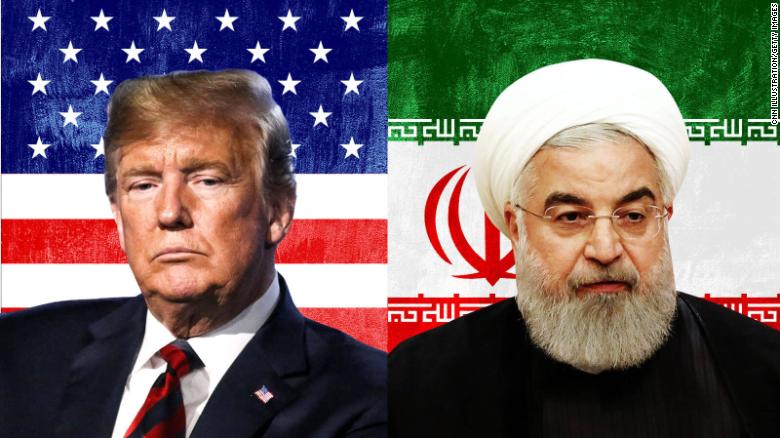
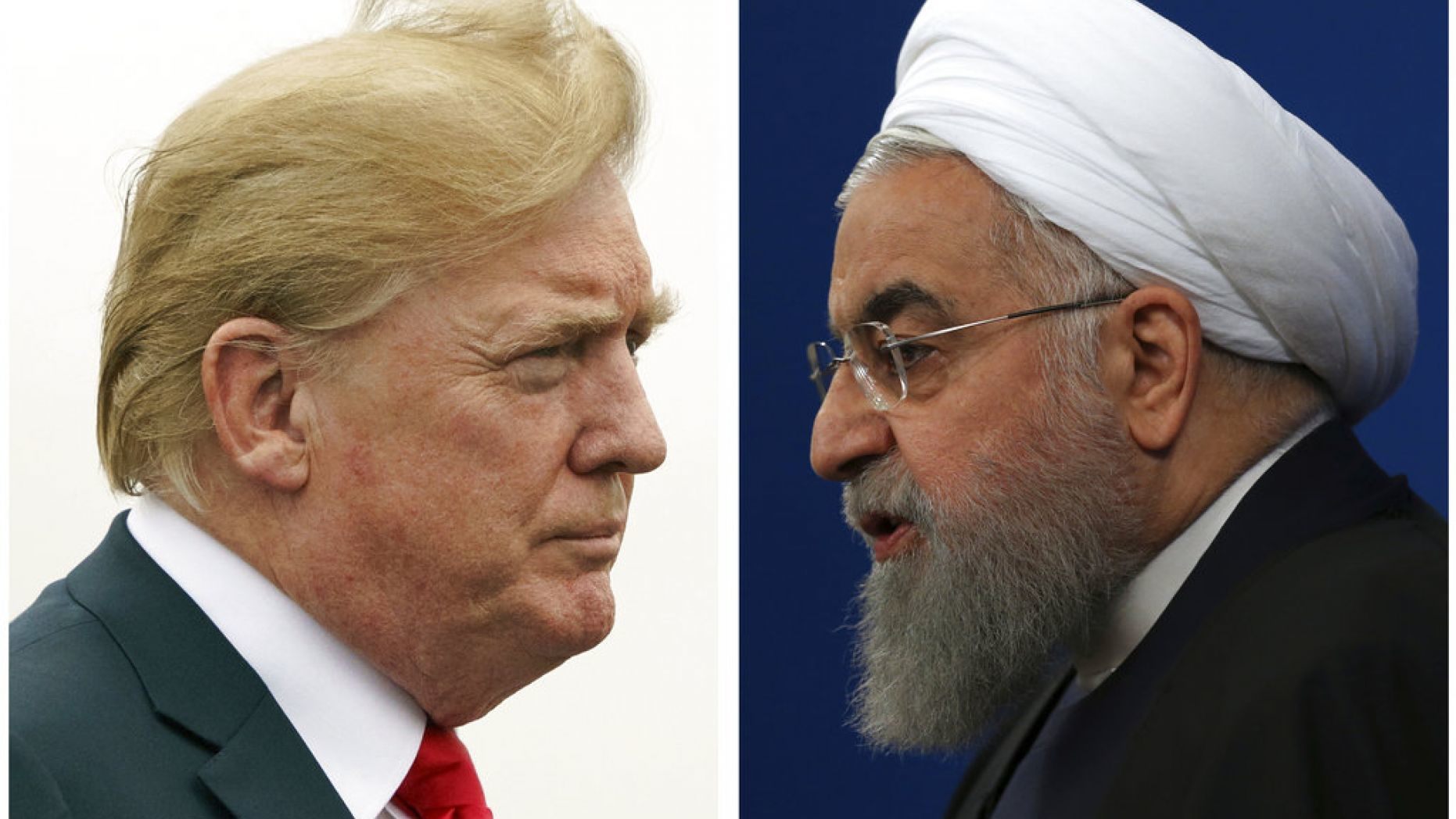
US sanctions, which place an embargo on oil and seek to cut off Iran’s banking sector from global markets, took effect on Monday. According to Reuters President Donald Trump called the sanctions an effective strategy. He called the 2015 deal “the worst in history”, implying that it does nothing to put restraints on Iran’s non-nuclear aggression, including the killing of dissidents abroad, its support of regional militant groups and its development of long-range ballistic missiles.
The sanctions take aim at Iran’s oil industry, a crucial element for its anaemic economy, and will end all the economic benefits America granted Tehran for its 2015 nuclear deal with world powers, though Iran continues to abide by the accord that saw it limit its enrichment of uranium.
The reimposition would lead to a bigger crisis in Iran, where the national currency, the rial, has plummeted over the last year, sending prices sky high.
Iran has launched air defence drills in response to the reimposition of US sanctions. The Iranian president, Hassan Rouhani, saying the country now faces “a war situation”.
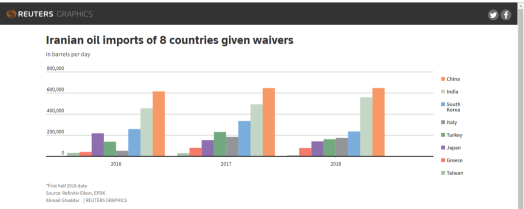
The US has, however, allowed several of its allies to continue importing Iranian oil. The eight countries, which are granted temporary waivers, are China, India, Italy, Greece, Japan, South Korea, Taiwan and Turkey, The Guardian reported.
But the sanctions will not affect Iran’s trade with the rest of the world. The European Union, for example, has implemented a special system for payments that allows companies to dodge the US measures. The so-called “special purpose vehicle” will provide a way for companies to move money in and out of Iran when Western banks won’t do that.
Media Coverage
I. Online news
Fox News talks about the mass anti-government protests at the end of last year, which resulted in nearly 5000 reported arrests and at least 25 people being killed.
Secretary of State Mike Pompeo explains the reasons for reimposing sanctions on Iran’s oil industry. He says, “They’re aimed at a single purpose – denying the world’s largest state sponsor of terror the capacity to do things like the things they’ve done in the past few weeks.”
The New York Times focuses on the Europe’s will to stay in the nuclear deal, as the Europeans consider it crucial to their national interests. It gives attention to the EU idea for “special purpose vehicle” and there’s another article especially for that.
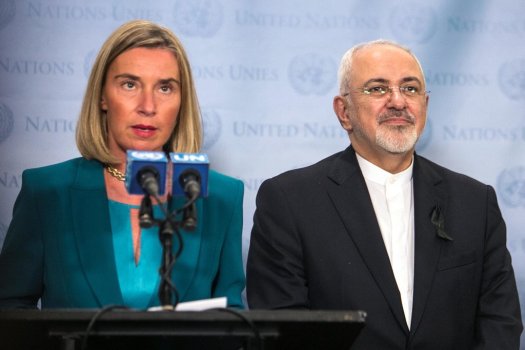
Federica Mogherini, the European Union’s top diplomat, and Mohammad Javad Zarif, Iran’s foreign minister
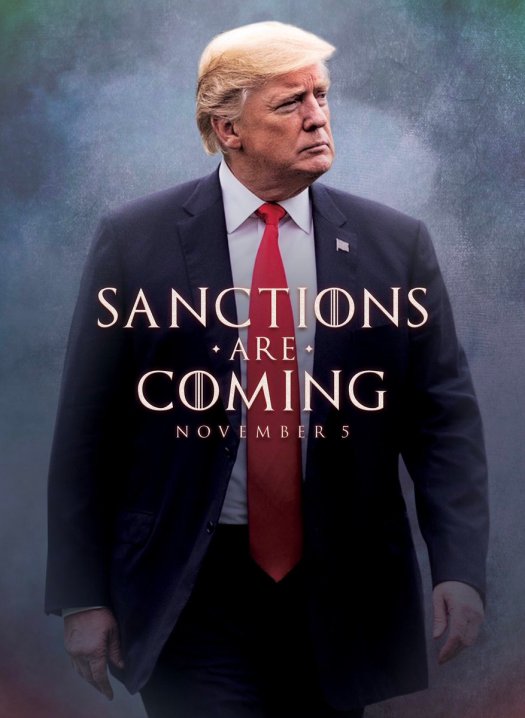
Huffington Post looks more on the bright side of life, analysing Donald Trump’s “Game Of Thrones”- style meme, which he posted on Friday, and the reactions it gets, most of them listed in the “WTF” category.
Meanwhile, I looked through people’s reactions on Twitter and I found an interesting “meme” response by Kirby James Wilson:
Another article highlights that sanctions seek to limit Iran’s ability to export oil by excluding companies which trade Iranian oil from doing business in the U.S. , but they will not affect Iran’s trade with the rest of the world. It points out that now Iran is not threatening to resume higher enrichment and it explains the importance of enriched uranium as a component of civil nuclear power generation and most nuclear weaponry.
The Guardian is the online source listing the names of all eight US allies that are granted temporary waivers.
In “Monday US briefing” it mentions that the sanctions, which took place on Monday, timed to coincide with the anniversary of the start of the Iran hostage crisis in 1979.
The BBC quotes US Secretary of State Mike Pompeo who said that Iran must “act like a normal country, or see its economy crumble”. On the other side, the president of Iran Hassan Rouhani insisted that Iran would “continue selling oil”. It explains quite well how the situation emerged and the consequences from it.
The CNN points out that the US withdrawal from the pact spurred an exodus of international companies from Iran, including European giants Total and Airbus. It reports that people fear sanctions may cause shortages of food and medicine, and an increase in youth unemployment.
The broadcast reports that according to Trump Iran is the single greatest threat to peace in the Middle East. The new sanctions would deprive Iran of money used for violent activities. Downing Street regreted the US decision and Britain would continue to support UK businesses expanding trade with Iran.
III. Newspapers
The Daily Telegraph explores the topic with the articles New sanctions prompt defiant ‘Death to America’ street protests in Iran and Sanctions should force Iran back to the table. The former highlights the insecurity the young generation has to face due to US sanctions. The latter points out that “the deal was supposed to foster stability in the Middle East, help the people of Iran and encourage moderate forces in the country- but it has done none of this”.
In our Introduction to Journalism lecture I was assigned to take a look at a particular media website (mine was Buzzfeed) and share a preview of it on my personal blog.
The name of Buzzfeed means “getting feed instantly” . The site contains stories with long, catchy headlines that are likely to appear on top of search engines. What is more, these written pieces have “to sell and not to tell”.
Viewers are encouraged to share the stories on social platforms, such as Facebook, Twitter, LinkedIn, etc.
Buzzfeed is mostly for entertainment and celebrity gossip, but it has a piece of seriousness too (although you cannot notice that at first sight). Advertisements are placed on the sidebar and parallel with “news”.
Its style is plain, not eye-irritating with sparkling colours, popping ads and subscriptions. The menu line is symmetrically divided – on the left we see the name of the site and five menus and on the right- the search engine alongside with five creative fast-click buttons that lead us to new content.
This site could appeal to the younger audience- from teenagers to young adults. It has sections with recipes, politics, parenting issues and even LGBT. To put it in a nutshell, it has a bite for everyone’s taste.
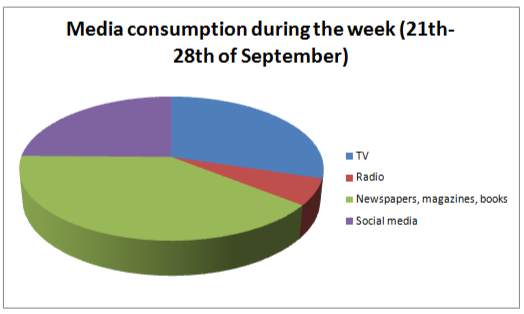
I had been monitoring my media consumption for a week (21th- 28th of September) and I put the results in a chart below:
It turns out, as I expected, that I spent most of my time in reading newspapers- in print or online (Evening Standard, The Guardian), magazines (Cosmopolitan, Writing, ES Magazine), excerpts from books (Media, Culture and Society by Paul Hodkinson, Why study the media? by Roger Silverstone) during my everyday travel from home to university and vice versa – 36 hours.
Some other 24 hours were spent by me watching TV at home after a hectic and yet exciting day in university (BBC, Sky News). In order for me to get a rest from the journalism world, I decided to post on social media and see how my friends’ day on Instagram was, and this took me 28 hours of my priceless time and a lot of my iPhone battery (after making this monitoring on consumption I am thinking of reducing the time spent on social media a bit) . Last, but not least, my radio consumption (BBC Radio 4) was 7 hours only.
The conclusion to be drawn from the above, is the fact that I tried to balance my active hours between keeping up with the news and getting in touch with friends, colleagues and relatives. The one thing I would like to correct is the time I spend on social media, so that I could have free hours for some extracurricular activities.
Felix Salmon’s piece of writing provides some good food for thought. My first reaction when reading the headline was, ‘Can’t journalists read properly, or is there something more than meets their eye?’ . It turns out, Felix has the ability to witness the biggest problems concerning journalism:
He believes that what is missing in the journalistic establishment is people who are good at finding and curating great material.
The main focus on Salmon’s speech during The Audit’s breakfast, is that the journalistic entities- newspapers, magazines, websites, have to start putting much more emphasis on reading. The reason why he emphasizes on this was because journalism is becoming much more conversational.
Think about it this way: reading is to writing as listening is to talking — and someone who talks without listening is both a boor and a bore. If you can’t read, I don’t want you in my newsroom. Because you aren’t taking part in the conversation which is all around you.
2. According to Dean Starkman, journalists who no longer work for old-fashioned media cannot be called ‘journalists’ , while Salmon thinks quite the opposite, and here lies the second issue- between old-fashioned and contemporary media.
Both of them produce material worth reading. The difference between ‘now’ and ‘those halcyon days’ is that today we have got more high-grade journalism available to the public than ever before.
3. And last, but not least, it is not about the shortage of journalists, but that of critical readers, who absorb the information, without misinterpreting it.
What makes one person a good journalist is his ability to read between the lines, to engulf fully in a situation until all points of view are considered. Everyone can be a publisher on Twitter or Facebook, but not everyone can create a content worthy of notice.





 Kristina's Writing Adventures